
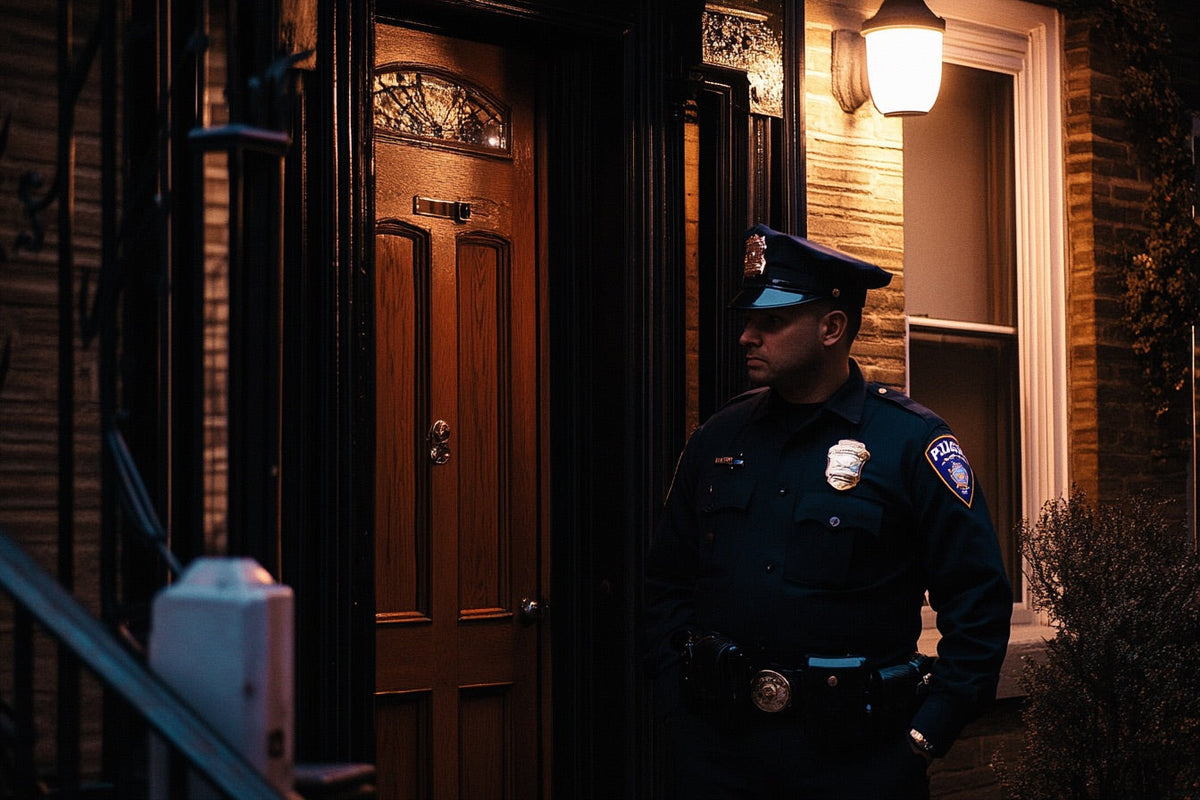
October is Domestic Violence Awareness Month, and in the 35th District Court a lot of domestic cases start the same way, with an argument at home, a 911 call, and a charge of domestic assault under MCL 750.81, a misdemeanor with a first offender program built into the law. Some of those cases start differently, and the difference is often a single sentence in the police report, a statement that someone's hands were on the other person's neck. That sentence turns a misdemeanor into assault by strangulation, a felony carrying up to 10 years, and it takes away almost every exit the misdemeanor would have offered. Understanding what that one word in the report does is the first step in defending the case built around it.
What is assault by strangulation in Michigan?
It's a felony under MCL 750.84(1)(b), added to the law in 2012 and in effect since April 1, 2013. The statute defines strangulation or suffocation as intentionally impeding normal breathing or the circulation of blood by applying pressure on the throat or neck, or by blocking the nose or mouth of another person. The penalty is up to 10 years in prison, a fine of up to $5,000, or both, and the prosecution can bring other charges from the same incident alongside it.
Two parts of that statute surprise people. The first is that it doesn't require any injury. Michigan's standard jury instruction for the offense says it doesn't matter whether the touching caused an injury, so the absence of marks, bruising, or a hospital visit doesn't decide the case. The second is that the statute isn't limited to domestic relationships. It applies to an assault on any person, which means a fight with a stranger outside a bar can be charged the same way.
How is that different from a domestic assault charge?
The difference is the entire structure of the case. A first domestic assault under MCL 750.81(2) is a misdemeanor punishable by up to 93 days in jail and a $500 fine, handled start to finish in district court. A second offense is up to one year, and a third becomes a five year felony. Aggravated domestic assault under MCL 750.81a, which requires a serious or aggravated injury, is a one year misdemeanor on a first offense. Strangulation skips that ladder entirely and starts at a 10 year felony.
Michigan's sentencing guidelines reflect that gap. Strangulation is a Class D crime against a person, while a third offense domestic assault is Class E. And a strangulation conviction counts as a prior for enhancing any later domestic assault, so it raises the stakes of every future case as well. For a broader look at who counts as a domestic partner under Michigan law, our piece on whether a fight with a roommate is domestic violence walks through the relationship categories.
What does a strangulation charge take off the table?
Most of the ways a first domestic case can end without a conviction. Michigan's first offender deferral under MCL 769.4a lets a person with no prior assaultive record plead to domestic assault, complete probation, and have the case dismissed, but the statute applies only to violations of 750.81 and 750.81a. A strangulation charge isn't eligible, so the program that resolves many first time domestic cases simply isn't available unless the charge itself changes.
The longer term consequences are just as serious. Strangulation is an assaultive crime under Michigan's set aside law, so it's excluded from the automatic Clean Slate process entirely, and a person can set aside no more than two assaultive convictions in a lifetime. A petition is possible only after a five year waiting period for a single felony, and a felony domestic violence conviction can never be set aside if the person already has a misdemeanor domestic violence conviction. A felony conviction also triggers Michigan's firearm ban under MCL 750.224f and the federal ban on possessing firearms after a felony, which matters for anyone who hunts or holds a concealed pistol license.
How does a strangulation case move through court?
It starts in the 35th District Court for arrests in Plymouth, Canton, and Northville, because district courts handle arraignments, bond, and the early stages of every felony. At arraignment the court sets bond, and in domestic cases bond commonly includes a no contact condition under MCL 765.6b, which can also bar firearms and, in some cases, add electronic monitoring. Violating that condition can mean a new arrest and the loss of bond.
Under MCL 766.4, a probable cause conference is held 7 to 14 days after arraignment, and the preliminary examination follows 5 to 7 days after that. The conference is where the prosecutor and defense discuss the case, including whether the charge should be reduced, and the preliminary exam is where a district judge decides whether there's enough evidence to send the felony to circuit court for trial. Those two dates come quickly, and they're the stage where the strangulation element itself gets tested for the first time.
Can the alleged victim drop the charge?
No. Michigan courts have held that the prosecutor alone decides whether to prosecute, and a trial court can't dismiss a domestic assault case because the complaining witness doesn't want to testify. A person can tell the prosecutor what they want, and that conversation can matter, but it doesn't end the case. Couples who have reconciled are often surprised to learn that the decision was never theirs to make once the 911 call went through.
Prosecutors also have tools for proceeding without live testimony. Statements made while someone was still under the stress of a startling event can come in as excited utterances under the Michigan Rules of Evidence, which often covers the 911 call and what was said to officers at the scene. And MCL 768.27b allows evidence of other acts of domestic violence by the defendant to be admitted in a domestic case, with notice, generally if those acts happened within the last 10 years. That's why a strangulation case can't be treated as something that will go away on its own.
What does a defense look at first?
The element that makes it a felony. The statute requires an intentional act that impedes normal breathing or circulation through pressure on the throat or neck, or blocking the nose or mouth, and each of those words carries weight. A grab at a shirt collar, a push near the shoulders, or a hand raised in a struggle isn't the same as what the statute describes, and the account in a police report written at midnight is often less precise than the charge that follows it.
From there the defense looks at what the evidence actually shows: the 911 recording, body camera footage, photographs, any medical examination, the timeline, and whether the description of what happened stayed consistent from the call to the report to the charging decision. Sometimes that review supports a reduction to a misdemeanor domestic assault, which reopens options the felony closed. Sometimes it supports taking the case to trial. Either way, the work happens best before the preliminary exam, not after.
What should you do if you're facing this charge?
Follow every bond condition exactly, including no contact even if the other person reaches out, because a violation creates a new problem on top of the felony. Don't discuss the incident with anyone, including in texts or on social media, and write down your own account of the night while it's fresh, for your lawyer only. Make a list of anyone who saw or heard what happened, and save any messages from before and after the incident.
Then get a lawyer involved before the probable cause conference, because that's the first chance to shape the charge. Our assault and domestic violence defense practice handles strangulation cases from arraignment in the 35th District Court through circuit court. Call Boria Law at (734) 453-7806, and Attorney Aaron J. Boria will review the report, the recordings, and the bond conditions with you and explain where the case is likely to go. A strangulation charge is built on one word in a police report, and the defense starts by testing whether that word fits what actually happened.
Quick answers
Is strangulation a felony in Michigan?
Yes. Assault by strangulation or suffocation under MCL 750.84(1)(b) is a felony punishable by up to 10 years in prison and a $5,000 fine, even on a first offense and even without a visible injury.
Can a strangulation charge be reduced to domestic assault?
It can, depending on the evidence. If the facts don't support the strangulation element, a prosecutor may agree to reduce the charge, or a judge may decline to bind it over at the preliminary exam. A reduction to domestic assault can reopen options like the first offender deferral.
Can you own a gun after a strangulation conviction in Michigan?
Not for years, and possibly not at all. A felony conviction triggers Michigan's firearm ban under MCL 750.224f, which lasts at least three to five years and can require a formal restoration, and federal law separately bars possessing firearms after a felony conviction.
Related reading
- Is a Fight With a Roommate Domestic Violence in Michigan?
- Charged With Domestic Violence in Michigan
- How Criminal Charges Affect Your Michigan CPL
Share:
Bow Hunting With a Pistol on Your Hip: Michigan CPL Rules and Drinking at Deer Camp
Is Taking a Campaign Yard Sign a Crime in Michigan?