
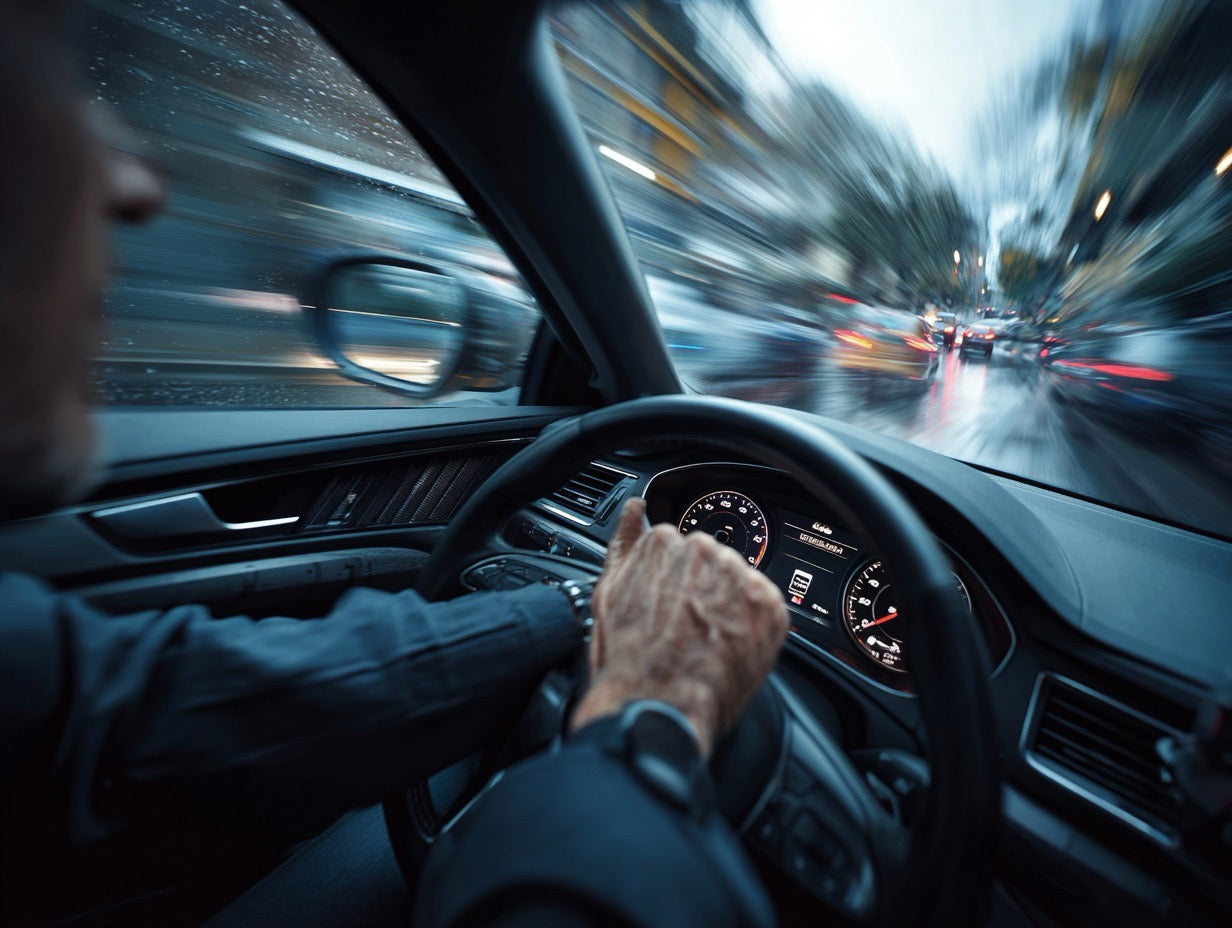
Most criminal charges in Michigan are about what a person did. Fleeing and eluding is about what a person did in the ten seconds after the flashers came on. A driver pulled over for a burned out taillight on Ann Arbor Road who panics and keeps going for four blocks has, in that moment, converted a civil infraction into a felony, because MCL 257.602a punishes the reaction rather than the reason for the stop. In nearly every fleeing case that comes through Western Wayne County the underlying violation was minor, a taillight, a rolling stop, an expired plate, and the flight is the entire case. How that flight gets explained, challenged, and negotiated in the first weeks decides whether the taillight stays a repair bill or becomes a felony record.
What does the prosecutor actually have to prove?
A fleeing and eluding conviction requires the prosecution to establish five things: that a police officer in uniform was performing lawful duties, that the defendant was the one operating the vehicle, that the officer gave a visual or audible signal to stop (by hand, voice, emergency light, or siren), that the officer's vehicle was identifiable as an official police vehicle, and that the defendant refused to obey by increasing speed, extinguishing lights, or otherwise attempting to flee. Every one of those elements is contestable, and several of them fail more often than people expect. A charge that sounds airtight in the police report often rests on a signal given from an unmarked car at a distance, or on an assumption about who was behind the wheel that nobody can actually prove.
How do the four degrees work?
Fourth degree under MCL 257.602a(2) is the baseline, a two year felony with a fine up to $500 and a one year license revocation, which means even the least serious version of this charge is a felony. Third degree under MCL 257.602a(3) is a five year felony with a fine up to $1,000, and it applies when the violation results in a collision or accident, when any part of the flight occurred where the speed limit is 35 mph or less, or when the driver has a prior fourth degree or attempted fleeing conviction. Second degree under MCL 257.602a(4) is a 10 year felony that applies when the violation results in serious impairment of a body function to any person or where the driver has certain prior convictions, and first degree under MCL 257.602a(5) is a 15 year felony with a fine up to $10,000 that applies when the violation results in death. Critically, the death or injury doesn't have to be the fleeing driver's fault in the ordinary sense, and it doesn't have to involve a person in the fleeing vehicle: a pursuing officer's crash, a bystander, or a passenger all qualify.
Why does the 35 mph provision matter so much?
That middle provision of third degree drives charging decisions across Wayne County, because nearly every residential street and downtown corridor in Plymouth, Canton, and Northville is posted at 35 or below. Consider two identical flights of two blocks each: one on a 50 mph stretch of Ford Road is fourth degree, a two year felony, while the same flight on a 25 mph residential street in Plymouth is third degree, a five year felony. Same conduct, same duration, same danger, different statute. Where the flight occurred is sometimes the single most litigated fact in the case, and the posted limit evidence for the specific stretch of road is worth examining carefully rather than taking the report's word for it.
What happens to your license?
A conviction at any degree results in mandatory license revocation, not suspension, and the difference matters enormously. Revocation is indefinite, with a minimum period that has to pass before a person can even petition the Secretary of State for restoration through a contested hearing, and fourth degree carries a minimum one year revocation while the higher degrees carry longer minimums. For most people, losing the license is a more disruptive consequence than the sentence itself, because it reaches the job, the kids' school runs, and everything else built around being able to drive.
What other charges usually ride along?
Fleeing rarely gets charged alone. Reckless driving under MCL 257.626 adds a 93 day misdemeanor with six points and a 90 day suspension, resisting and obstructing under MCL 750.81d is a two year felony that gets charged alongside routinely, and OWI under MCL 257.625 is frequently the reason the person fled in the first place. If the pursuit caused damage, malicious destruction of police property can attach, and if a weapon was in the vehicle, felony firearm under MCL 750.227b adds a mandatory consecutive two years. Each added count changes the negotiating landscape, which is one more reason the case needs attention before charging decisions harden.
Which defenses actually work?
The statute requires a visual or audible signal from a vehicle identifiable as a police vehicle, and unmarked cars, brief light activation, and signals given from behind at a distance all create genuine factual disputes, with dashcam footage frequently showing the signal was far less clear than the report describes. The offense also requires an intent to flee, so a driver with music playing who didn't perceive a siren, or who was looking for a safe place to pull over, didn't form that intent, and Michigan case law recognizes that continuing a short distance to reach a safe, lit location isn't fleeing. That's a real and frequently successful defense: Michigan State Police and many local agencies explicitly advise drivers, particularly women driving alone at night, to continue to a well lit public area before stopping. Beyond that, if the attempted stop itself lacked reasonable suspicion the lawful duties element fails, and identity is genuinely in dispute in the many cases that end with the vehicle found abandoned, because registration establishes ownership, not who was driving. Duress or necessity is narrow but real in specific circumstances, such as a medical emergency in the vehicle. In practice most fleeing charges in Western Wayne County come from a handful of recurring situations, a driver with a suspended license who panics, a driver who's been drinking, a young driver who doesn't realize the lights are for them, a driver looking for a safe place to stop who gets charged for the delay, or a person with an outstanding warrant, and in nearly all of them the reason for the stop was minor.
What should you do in the first week?
The early moves in a fleeing case are concrete, and they're worth treating as a checklist:
- Say nothing about who was driving, where you were going, or why you didn't stop.
- Don't consent to any search.
- Preserve your own dashcam footage immediately.
- Note the exact route and the posted speed limits along it.
- Identify passengers and any witnesses.
- Document lighting, weather, and traffic conditions.
- Get counsel to request police dashcam and body camera footage promptly, because that footage is the case.
The reduction is the whole game
The Holmes Youthful Trainee Act doesn't apply to traffic offenses, which excludes fleeing and eluding, so for young defendants the strategy has to be charge reduction, to reckless driving or to a lesser degree of fleeing, rather than deferral. The difference between a fleeing conviction and a reckless driving conviction is the difference between a permanent felony with license revocation and a misdemeanor with a 90 day suspension, and that reduction is achievable in a meaningful number of cases, but only where someone challenges the signal, the knowledge, and the identity elements early. Cases arising in Plymouth, Plymouth Township, Canton, and Northville are arraigned in the 35th District Court in Plymouth, then proceed through probable cause conference and preliminary examination before bind over to Wayne County Circuit Court, and our Michigan traffic offense defense practice handles these cases at both stages. Call Boria Law at (734) 453-7806 if you or someone in your family is facing this charge. Attorney Aaron J. Boria defends fleeing and eluding cases in the 35th District Court and Wayne County Circuit Court, requesting the footage and litigating the elements early so the taillight stays a repair bill instead of a felony record.
Quick answers
How long before I can drive again after a fleeing conviction?
The revocation is indefinite, with a minimum of one year for fourth degree and longer minimums at higher degrees, and it doesn't end automatically. You have to petition the Secretary of State for restoration through a contested hearing and prove you deserve the license back, which is a separate proceeding with its own preparation. That's one of the biggest reasons keeping the conviction off the record in the first place matters so much.
Can a fleeing and eluding conviction be expunged later?
Generally no. Michigan's Clean Slate expungement law excludes most traffic offenses, and fleeing and eluding falls in that category, so a conviction is effectively permanent. The realistic path to protecting the record is at the charging and negotiation stage, through a reduction to reckless driving or a lesser degree, not through cleanup years later.
What footage matters, and how fast does it disappear?
Police dashcam and body camera footage is usually the single most important evidence, because it shows how clear the signal actually was and how long the alleged flight lasted. Agencies retain that footage on limited schedules, so counsel should request it in the first days of the case, and your own dashcam footage should be copied and preserved immediately before it's overwritten.
Related reading
- Charged With Racing on a Public Highway in Michigan: MCL 257.626a Explained
- Michigan Reckless Driving and Exhibition of Speed Explained
- Suspended License in Michigan: The Most Common Charge Is Also the Most Preventable
Share:
Michigan Trespass and Loitering Charges at Parks, Pools, and Closed Businesses
Charged With Domestic Violence in July? Why Summer Is Michigan's Peak Season